top of page

Written by Paul C. Bastante, CAPSCertified Aging in Place Specialist for “The Agewise Institute” and brought to you by 101 Mobility North Jersey


Cognitive Dissonance in Real Life: Why We Defend What We Know Isn’t Quite Right


I’ve been thinking a lot about cognitive dissonance lately. Not in a textbook kind of way. Just in the way you start noticing something once you have a name for it. 


Cognitive dissonance is that nagging feeling you might notice when what you believe doesn’t match what you actually do. I sometimes feel that someone


can be a “good” person and also hold two separate beliefs that don’t sit well together. It's a subtle thing. More of a quiet internal mental shift. And it usually happens when something or someone challenges the version of yourself that you prefer.


It is something that we consider to be a mental health concern because interpersonal relationships as well as public and direct response affects the way that we are seen. The way we are seen influences how we view ourselves and this has a direct impact on our mental health.


Most of us do not experience cognitive dissonance as a flashing red light, or something tangible. It’s more like an irritation. It’s the sudden urge sometimes to explain. Have you ever felt this? You’re not alone! It’s an actual thing. 


Introduced by Leon Festinger in the 1950’s. The basic idea was that human beings are wired for internal consistency. We want our beliefs and our behaviors, with regard to our identities to match up. When they don't, we instinctively move to restore that balance. 


What does THAT mean? As human beings, we do not usually look to change our own behavior first…We usually take the easy road and change the story instead. Almost like an internal governor designed for defense against having to recognize ourselves as the issue. And hence forth then?  “Cognitive dissonance”. 


Look at it like this, If you believe you are disciplined but you skip something important, you might tell yourself “I needed the break”. If you believe that you are an open-minded person, but you dismissed someone immediately, you might frame that as discernment. If you see yourself as fair but react strongly to something that you dislike, you may call it principle.


My point is not that these explanations aren’t always false. Only sometimes they are accurate. The issue is that we are rarely neutral when thinking of ourselves. We are subconsciously motivated to protect our self-image and the image in the eyes of those we see as important.


Right now, culturally speaking, we are living in a moment where cognitive dissonance is not only amplified, but actually commonplace. Information today moves at breakneck speed. Opinions form even faster. Every event comes with commentary before facts have settled. 


Many of us agree that social media platforms reward certainty and punish hesitation and that means that the fastest reaction in the room often sounds like the loudest. It is a difficult environment to navigate sometimes because speed does not necessarily promote accuracy or reason.


When we encounter information that challenges our existing views, we really only have three viable options:


  • We can pause and examine it. 

  • We can adjust our position. 

  • Reinterpret the new information so it fits our existing narrative. 


The last option is usually the easiest. We all understand that as human beings we mostly choose the path of least resistance. 


It is easier to question the source than to question ourselves


You see this across every ideology, every demographic, every age group. No one is immune. I am not immune. You my friends are not immune!


Cognitive dissonance also shows up in quieter ways.

We say we value civil discourse but most of us only engage with people who already agree with us. We say we want unity yet assume the worst about anyone outside our circle. We claim to care about truth but skim headlines instead of reading full articles. 

Again, none of this makes any of us villains. It just makes us human. But it is worth considering…What would it be like, if the path of least resistance was also the path less travelled? Think about it.


The speed of modern life intensifies the pressure. We are naturally more reactive when the bullets are flying. There is very little room for reflection. We are asked to respond instantly to events that deserve careful thought. When careful thought is applied things feel different. 


Another layer is our identities themselves. Many beliefs are no longer just opinions. They are tied to who we think we are. When a belief becomes part of identity, when that belief is challenged it often feels personal. That is when cognitive dissonance moves to the front of the line.


If someone questions a policy I support, I may hear it as a question about my character. If someone critiques a position I have taken publicly, I may feel attacked. Our brains move quickly to defend the rest of us. The defense can look like dismissal and sarcasm. And the reaction many times is to double down. The deeper the identity attachment, the stronger the reaction.


There is also a private version of this that does not involve politics at all. It shows up in relationships. It appears at work. It surfaces in how we see ourselves as parents, partners, leaders, or friends.


What I find interesting is that cognitive dissonance is not proof of hypocrisy. The discomfort exists because we want alignment within ourselves. That is not a bad thing. The question is more about how we respond to it. Our own reactions.

When we feel defensive about something, we should try to ask ourselves why.


Before we react. I am guilty at times of feeling certain in a way that leaves no room for doubt. In the future I plan on trying to slow it down. That does not mean that I am abandoning my convictions. It just means holding them without presenting myself as infallible. Arrogance? 


There is strength in being able to say, “I may need to think about that.” before deciding to react. There is a certain stability in admitting that perhaps you had not considered that angle. Sometimes, this is not a trait of a weak person but of a strong and confident one.


In the current climate, this approach is not common. It is not trendy to display open arrogance, whether intentional or not.  It requires restraint. 


Cognitive dissonance will never disappear. It is built into the way we process the world. The goal is not to eliminate it. The goal is to become aware of it. To be open to communicating your views to the world in a constructive way. 


When you notice that tightening feeling in your chest during a conversation, that may be dissonance. When you feel the urge to correct someone before they finish speaking, that may be dissonance as well. When you immediately search for reasons the other side is dishonest instead of considering their argument, YOU may be Cognitively dissonant.


We do not need to abandon conviction to avoid being rigid. We do not need to avoid disagreement to remain respectful. We do not need to pretend everything is equal to acknowledge that we can learn from people who see the world differently.

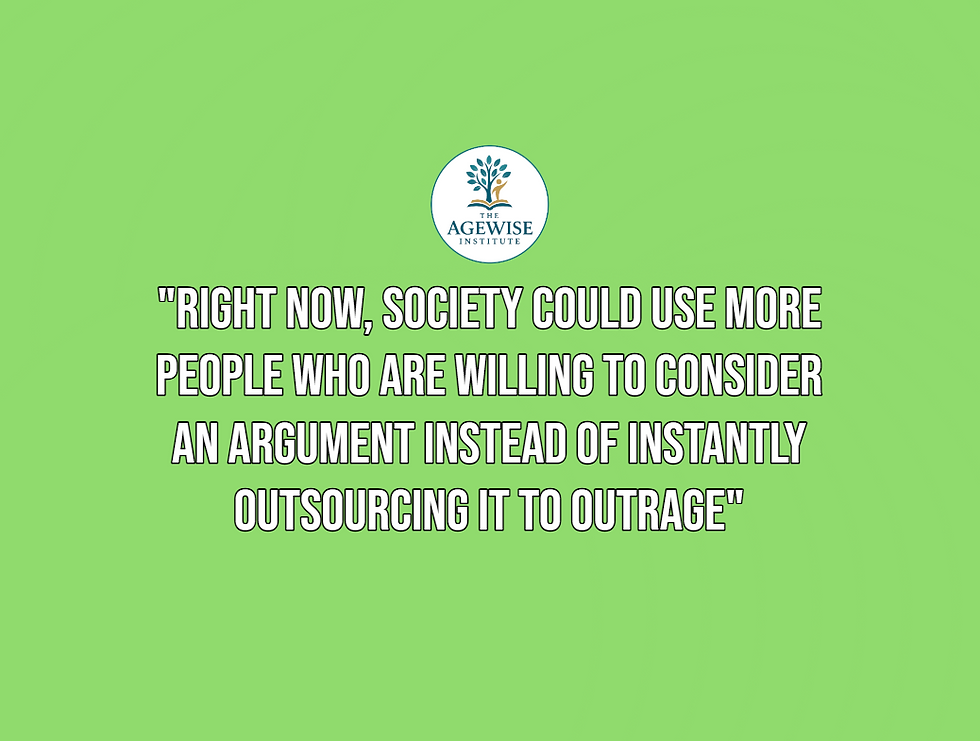
Right now, society could use more people who are willing to sit with discomfort instead of outsourcing it to outrage. Read that again for retention.


We could use more conversations that begin with curiosity rather than accusation. We could use more pauses before conclusions.


Cognitive dissonance will always be part of human nature. It shows up where reality collides with belief. The question is whether we allow it to push us toward growth or toward defensiveness.


If we can learn to recognize this and be thoughtful and considerate in our responses, we will be better able to address more substantive matters.


What do you think? I would like to know. Paulcbastante@Gmail.Com


Written by Paul C. Bastante, CAPS – Certified Aging in Place Specialist for “The Agewise Institute” and brought to you by 101 Mobility North Jersey


Social Connection, Super Agers, and the Quiet Power of Staying Engaged as We Age

Written by Paul C. Bastante, CAPS – Certified Aging in Place Specialist for “The Agewise Institute” and brought to you by 101 Mobility North Jersey


Socialization is the thing that we continually come back to as the most identifiable shared characteristic among Super Agers.

There is a phrase that has been gaining traction in gerontology and neuroscience over the last decade: “Super Agers.” It sounds like a marketing term, but it isn’t. Researchers use it to describe a small but fascinating segment of older adults—typically age 80 and beyond—who retain cognitive abilities comparable to people 20 or 30 years younger.


Naturally, everyone wants to know the secret.


Is it genetics? Diet? Crossword puzzles? Red wine? Daily kale smoothies consumed while standing on one leg and lifting dumbbells with a spare hand?


Here’s the spoiler: while all of those things may play a role, the most consistent commonality among Super Agers is strong, ongoing social connection. It has little to do with supplements. It definitely isn’t some app on your phone. It is human connection, plain and simple.


As someone who works every day at the intersection of aging, independence, safety, and quality of life, I want to slow this conversation down and bring it out of the research journals and into real life—for seniors themselves, for families, and for the professionals who support them.


Because socialization is not a “nice-to-have” in aging. It is infrastructure.


What the Research Actually Shows


Let’s ground this in data.


  • A landmark Harvard Study of Adult Development, which has followed participants for over 80 years, concluded that close relationships—not wealth, fame, or IQ—are the strongest predictor of long-term health and happiness, including cognitive health in later life.

  • According to the National Institute on Aging, social isolation is associated with:

    • A 50% increased risk of dementia

    • A 29% increased risk of heart disease

    • A 32% increased risk of stroke

  • A 2020 meta-analysis published in The Journals of Gerontology found that strong social ties reduce mortality risk by approximately 45%, a protective effect comparable to quitting smoking.


Now let’s flip that around.


Among older adults identified as Super Agers in Northwestern University’s research, investigators consistently noted:


  • Frequent engagement with friends, family, or community groups

  • Continued participation in group-based activities

  • A strong sense of purpose tied to relationships, not just routines


In plain English: their brains stayed sharper because their lives stayed connected.


Socialization Is Not the Same as “Being Busy”


This is an important distinction, especially for professionals reading this.

Socialization is not simply filling time. You can be busy and still isolated. True social engagement involves:


  • Reciprocity

  • Conversation

  • Emotional presence

  • Shared experience


Watching television all day with a spouse in the same room does not count. Neither does scrolling social media or sitting silently in a crowded space.

What matters is interaction that stimulates emotional and cognitive engagement.

From a brain-health standpoint, social interaction activates multiple systems at once:


  • Language processing

  • Memory recall

  • Emotional regulation

  • Executive function


It’s a full workout—without a treadmill.


Why Socialization Declines With Age (Even When People Want It)


Here’s the uncomfortable truth: most seniors don’t stop socializing because they don’t want to. They stop because barriers quietly stack up.


Some of the most common:


  • Mobility challenges that make outings feel exhausting or unsafe

  • Transportation limitations after driving becomes difficult

  • Hearing or vision changes that make conversation frustrating

  • Loss of peers through illness, relocation, or death

  • Fear of being a burden


As a CAPS professional, I see this constantly. A person’s world doesn’t shrink overnight—it narrows inch by inch until staying home feels easier than trying.

This is where families and professionals can unintentionally miss the moment. By the time loneliness becomes obvious, it has usually been present for years.


Practical, Real-World Ways Seniors Can Stay Socially Engaged


Socialization does not have to mean “join a club” or “be extroverted.”

It should however be sustainable, accessible, and meaningful.


Here are evidence-informed, realistic approaches that work.


1. Routine-Based Social Anchors


Consistency matters more than intensity. Weekly or biweekly activities outperform occasional big events in maintaining cognitive engagement.

Examples:


  • Standing coffee dates

  • Weekly walking groups

  • Faith-based gatherings

  • Book or discussion groups

  • Community lectures or history talks


From a neurological standpoint, predictable social routines reinforce memory pathways and reduce anxiety.


2. Purpose-Driven Interaction


One of the strongest predictors of ongoing engagement is usefulness. Older adults who feel needed socialize more—and benefit more.

Options include:


  • Mentoring programs

  • Volunteering in schools or libraries

  • Peer support groups

  • Informal caregiving roles

  • Advisory or committee participation


A 2019 study in Psychology and Aging found that older adults who volunteered at least two hours per week showed better executive function and lower depression scores than non-volunteers. Purpose fuels connection.


3. Intergenerational Socialization


This deserves more attention than it gets.


Research consistently shows that intergenerational interaction improves mood, memory recall, and emotional resilience in older adults.

It does not need to be formal.


  • Regular family dinners

  • Story-sharing with grandchildren

  • Community programs pairing seniors with students

  • Technology tutoring sessions led by younger participants


Brains thrive on novelty, and nothing is more novel than a different generation’s perspective.


4. Designing the Environment for Social Access


This is where aging-in-place intersects directly with social health. If a home environment makes leaving difficult, socialization declines—even when motivation remains.


Common barriers:


  • Stairs without railings

  • Poor lighting

  • Unsafe entryways

  • Bathrooms that discourage independence

  • Lack of seating near entrances


Small, strategic modifications often unlock big social gains.

When people feel safe getting in and out of their home, they say “yes” more often.


5. Leveraging Technology—With Guidance


Technology can support socialization, but it should never replace it. Video calls, group chats, and online interest groups can supplement in-person interaction, especially for:


  • Seniors with mobility limitations

  • Long-distance family connections

  • Bad weather or seasonal isolation


The key is supportive onboarding. Frustration kills adoption. Confidence builds consistency.


What This Means for Professionals Supporting Older Adults


For PTs, OTs, social workers, discharge planners, and care managers, socialization should be treated as a functional domain—not an afterthought.

Ask:


  • Who does this person interact with weekly?

  • How do they get there?

  • What makes it hard?

  • What would make it easier?


When social engagement improves, downstream outcomes often follow:


  • Better adherence to therapy

  • Lower fall risk

  • Reduced depression and anxiety

  • Improved cognitive resilience

  • Greater satisfaction with care plans


Social health is preventive care.


For Families: A Gentle Reframe is sometimes all that it takes to help.


Encouraging a loved one to socialize is not about pushing them out the door. It’s about removing friction.


Instead of asking:


“Why don’t you go out more?”


Try:


“What makes it harder than it used to?”

Support, not pressure, keeps dignity intact.


The Big Takeaway? Super Agers are not superhuman!


They are connected. They stay engaged with people, ideas, routines, and purpose long after others withdraw—not because aging treated them better, but because their lives stayed relational.


Longevity without connection is survival. Longevity with connection is living.


Let’s Bring This Conversation to Your Organization


If you work in healthcare, senior services, caregiving, or community programming—and you want a grounded, research-informed, real-world discussion and presentation about socialization, aging, and independence—I’d love to come speak with your team.


I offer engaging presentations for:


  • Senior living communities

  • Rehab and therapy practices

  • Social work departments

  • Caregiver groups

  • Community organizations and faith-based groups


Book me to speak at your next office function, in-service, or gathering.

Together, we can turn research into action—and help more people age not just longer, but better.


If you’d like, I can also adapt this topic for caregivers only, clinical teams only, or mixed audiences. For bookings, please call me or text me @ 973-981-3662.


Written by Paul C. Bastante, CAPS, for The AGEWISE Institute. Proudly sponsored by 101 Mobility North Jersey, OPM Remodeling & My Jersey Handyman 


Groundhog Day, Aging in Place, and Why “Six More Weeks of Winter” Actually Matters


Every February 2nd, we collectively turn our attention to a groundhog in Pennsylvania and ask him one very important question:


Are we done with winter yet?


Whether Punxsutawney Phil sees his shadow or not, Groundhog Day taps into something very human—our relationship with routine, repetition, and time.


Winter can feel like the same day on repeat. Cold mornings. Slippery steps. Short daylight hours. And for older adults or anyone with mobility challenges, that repetition isn’t just annoying—it can be risky.


That’s where aging in place quietly enters the chat.


Winter is when homes get stress-tested


Winter doesn’t create problems—it reveals them.


  • Steps that were “fine all summer” suddenly feel steep and icy

  • Bathrooms get colder, floors get slicker

  • Muscles stiffen, balance changes, reaction time slows

  • Trips outside decrease, meaning more time navigating the home itself


For people aging in place, winter is often the season when near-falls happen, confidence dips, and families start asking bigger questions.


Groundhog Day is really about preparedness


At its core, Groundhog Day asks: Are we ready for what’s next?

In aging in place, the question is similar:


  • Is the home ready for another winter?

  • Are safety features proactive—or reactive?

  • Are small risks quietly repeating themselves every day?


Because the truth is, most falls don’t happen during dramatic moments. They happen during ordinary, repetitive routines:


  • Stepping into the shower

  • Standing up from the toilet

  • Navigating the same hallway, again and again


Sound familiar? That’s the Groundhog Day effect—the same motion, every day, until one day it goes wrong.


Aging in place is about breaking the cycle


The goal of aging in place isn’t to change daily life—it’s to support it.

Simple home modifications can interrupt risky routines before they become emergencies:


  • Grab bars in bathrooms for daily stability

  • Improved lighting during darker winter days

  • Secure entry points when snow and ice linger

  • Small adjustments that reduce strain and increase confidence


These changes don’t announce themselves. They just work—quietly, every day.


“Six more weeks of winter” isn’t the real takeaway


Whether winter lasts six more weeks or not, the bigger takeaway is this:

Time keeps moving. Bodies change. Homes should adapt.


Groundhog Day reminds us that seasons repeat—but our needs don’t stay frozen in time. What worked last winter may not work this one. And waiting for a scare to make changes is like waiting for Phil to predict a fall.


Not the best strategy.


A gentle nudge, not a dramatic overhaul


Aging in place isn’t about turning a home into something unrecognizable. It’s about making sure the everyday routines—the ones we repeat over and over—remain safe, comfortable, and dignified.


Because the best outcome isn’t a dramatic rescue or a rushed solution.

It’s waking up tomorrow… and the next day… and the next…

and doing the same things you’ve always done—safely.

No shadow required.


If you want, I can:


  • Localize this for North Jersey winters

  • Add a short family-focused CTA

  • Pair it with a Grab Bar or Bathroom Safety follow-up post

  • Or format it for email + social with a lighter tone


Groundhog Day may be once a year—but home safety is an everyday 🐿️.


WELCOME TO THE AGEWISE BLOG

bottom of page