


How to Prepare Your North Jersey Home for a Loved One’s Return After Surgery
- Paul C. Bastante

- Jun 9
- 8 min read
How to Prepare Your New Jersey Home for a Loved One’s Return After Surgery
Written by Paul C. Bastante, CAPS, BDM for Jersey Stairlifts And Ramps and brought to you by The Agewise Institute
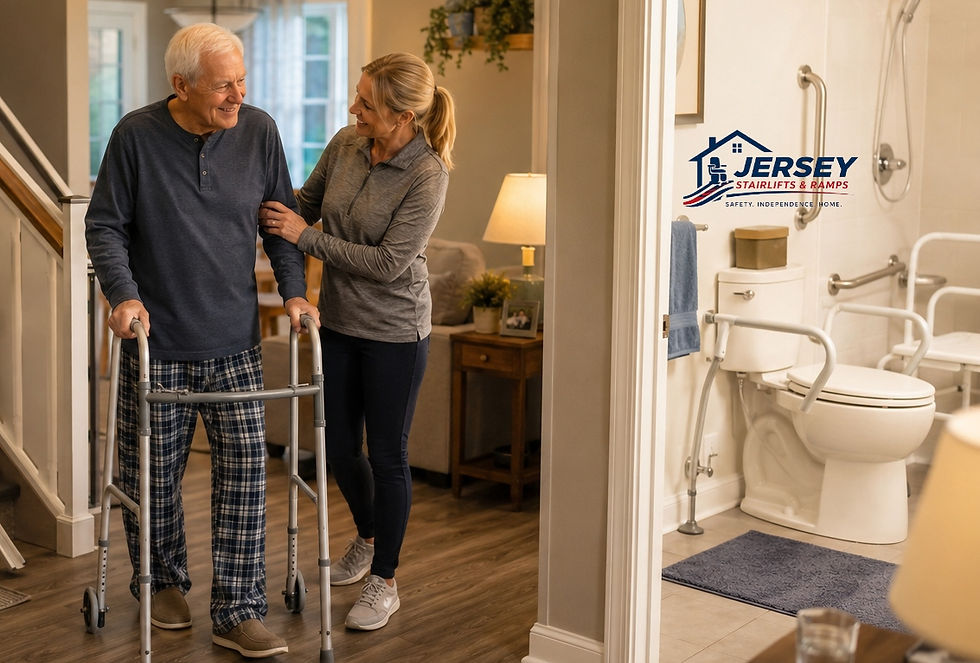
The phone call comes and suddenly everything changes. Your mom is being discharged on Friday. Your husband is coming home after his knee replacement sooner than expected. Your father’s hip surgery went well but the hospital wants him out by the weekend. Whatever the situation, the feeling is the same — relief mixed with a sudden, urgent question: Is our home actually ready for this?
For most New Jersey families the honest answer is no. Not because you haven’t thought about it, but because home safety during recovery is something nobody really prepares for until they have to. The good news is that with a few focused changes you can make your home dramatically safer before discharge day. This guide walks you through exactly what to do, room by room, so your loved one comes home to a safe and comfortable environment — not a new set of obstacles.
WHY HOME PREPARATION MATTERS MORE THAN MOST FAMILIES REALIZE
Hospitals and rehab facilities are designed for recovery. Everything is at the right height, floors are clear, staff are nearby, and there are no stairs between the patient and what they need. The moment your loved one walks through the front door of a typical New Jersey home, all of that changes.
Most homes in Northern New Jersey were not built with post-surgical mobility in mind. Split-level homes in Wayne and Parsippany, colonial-style homes in Ridgewood and Mahwah, and raised ranch properties throughout Passaic and Bergen County all share one common challenge — stairs. Stairs between floors. Stairs at the entry. Stairs to the basement laundry. Stairs that were never a problem before surgery can become genuinely dangerous barriers during recovery.
Falls during post-surgical recovery are a leading cause of setbacks, re-hospitalizations, and in some cases permanent complications. The time to address your home is before your loved one arrives — not after an incident.
START HERE — THE DISCHARGE DAY CHECKLIST
Before you do anything else, get clear on your loved one’s specific restrictions. Every surgery is different and your orthopedic surgeon or physical therapist will give you specific guidelines. Common restrictions after knee replacement, hip replacement, and back surgery include:
No bending past 90 degrees. No crossing the legs. Limited weight bearing on the surgical side. No twisting at the waist. Restricted range of motion for weeks or months. Fatigue that makes even short distances feel long.
Keep these restrictions in mind as you go through each area of the home. Every modification you make should be measured against the question: can my loved one do this safely given their specific restrictions?
THE STAIRS — YOUR MOST URGENT PRIORITY
If your New Jersey home has stairs — and most do — this is where you need to focus first and fast.
Stairs are the single biggest fall risk during post-surgical recovery. They require balance, strength, and range of motion that many patients simply do not have in the weeks immediately following surgery. Even patients who are told they can “manage stairs carefully” by their surgical team face real danger every time they attempt a staircase without proper support.
There are three options for managing stairs during recovery:
Option 1 — Avoid Them Entirely
If your loved one can live on one floor during recovery — sleeping, bathing, and eating without using the stairs — this is the safest short-term solution. Set up a temporary bedroom on the ground floor if possible. Move everything they need to one level.
Option 2 — Handrail Upgrades
If stairs must be used, make sure both sides of every staircase have a sturdy, graspable handrail. Loose or wobbly handrails are extremely dangerous for someone with compromised balance and strength. Have them checked and reinforced before discharge day.
Option 3 — Install a Stairlift
For many New Jersey families, a stairlift is the most practical, safest, and most immediate solution. A stairlift eliminates the physical demand of climbing stairs entirely. The patient sits comfortably and rides between floors with no weight bearing, no balance requirement, and no risk of a fall on the staircase. For post-surgery recovery specifically, a stairlift rental is often the perfect solution — professionally installed before discharge day and removed when recovery is complete.
If stairs are a concern in your home — and you are not sure whether your loved one can safely manage them during recovery — call us at 973-490-4375 before discharge day. We can often schedule a free in-home consultation and complete installation within 24 to 72 hours.
THE BEDROOM — SET IT UP FOR RECOVERY
The bedroom is where your loved one will spend most of their recovery time. Make it as safe and accessible as possible before they arrive home.
Bed Height
The bed should be at a height where your loved one can sit down and stand up without excessive bending or straining. Too low is dangerous — getting up from a low bed puts enormous stress on a healing hip or knee. If necessary add a bed riser to bring the mattress to the right height. A firm mattress is generally better than a soft one during orthopedic recovery.
Clear the Path
Remove any rugs, cords, furniture, or clutter between the bedroom door and the bed. Your loved one will be navigating this path in the middle of the night, possibly with a walker or cane, possibly in low light. A clear path is a safe path.
Bedside Essentials
Set up a bedside table with everything your loved one will need within arm’s reach — water, medications, phone, TV remote, reading glasses. Reducing unnecessary movement reduces risk.
Nightlight
Install a nightlight between the bedroom and the bathroom. Falls happen most often at night when patients get up to use the bathroom. A lit path makes a real difference.
THE BATHROOM — THE SECOND HIGHEST RISK AREA
After stairs, the bathroom is where most post-surgical falls happen. Wet surfaces, awkward movements, and the physical demands of getting on and off the toilet make the bathroom a genuinely dangerous space during recovery.
Grab Bars
Install grab bars next to the toilet and inside the shower or tub before discharge day. These are not optional. A grab bar next to the toilet allows your loved one to lower themselves down and push themselves back up without putting full weight on the surgical joint. Make sure grab bars are professionally anchored into wall studs — not just drywall.
Raised Toilet Seat
A raised toilet seat reduces the depth your loved one has to lower themselves, which is critical for hip replacement patients who cannot bend past 90 degrees. These are inexpensive and widely available at medical supply stores.
Shower Chair or Bench
Standing for the duration of a shower is exhausting and dangerous during early recovery. A shower chair or bench allows your loved one to bathe safely while seated. A handheld shower head makes this even easier.
Non-Slip Mat
Place a non-slip mat inside the shower and on the bathroom floor outside the tub. Wet tile is extremely slippery and a fall in the bathroom during recovery can be catastrophic.
Remove the Tub If Possible
If your loved one has a separate walk-in shower, use that instead of the tub during recovery. Getting in and out of a tub requires a range of motion that many post-surgical patients simply do not have safely.
THE LIVING AREAS — CLEAR, ACCESSIBLE, AND SAFE
Remove Throw Rugs
Throw rugs and area rugs are one of the most common tripping hazards in the home. Remove them entirely during the recovery period. No rug is worth a fall.
Furniture Arrangement
Rearrange furniture to create wide, clear pathways between the rooms your loved one will use most — bedroom, bathroom, kitchen, and living room. Your loved one may be using a walker or cane and needs space to maneuver safely.
Favorite Chair Height
Like the bed, your loved one’s primary sitting area should be at a height that allows them to sit and stand without excessive strain. Add a firm cushion to a low chair if necessary. Avoid deep, soft sofas that are difficult to get out of.
Extension Cords and Cables
Tape down or remove any extension cords, charging cables, or other items on the floor that could catch a foot or walker leg. These are invisible hazards especially in low light.
THE KITCHEN — REDUCE THE NEED TO MOVE
During the first weeks of recovery your loved one should be doing as little unnecessary movement as possible. Set up the kitchen so that everything they use daily is within easy reach without bending, stretching, or opening low cabinets.
Move frequently used items — coffee, glasses, plates, medications — to counter height or upper cabinets that do not require bending. If your loved one will be spending time in the kitchen, make sure there is a sturdy chair or stool available so they can sit while preparing food rather than standing for extended periods.
A rolling cart or caddy can be incredibly useful for moving items around the home without carrying them — particularly helpful for patients who need both hands on a walker.
THE ENTRY — DON’T OVERLOOK THE FRONT DOOR
Many New Jersey homes have steps at the front entry that are easy to forget about until your loved one is standing on the sidewalk trying to get inside. Check your entry before discharge day.
If there are steps at the front or side entry, make sure there is a sturdy handrail on at least one side. If steps are steep or numerous, consider whether a temporary or permanent wheelchair ramp would make entry and exit safer. For patients who use a wheelchair, walker, or who have significant mobility restrictions, a ramp can be transformative.
Jersey Stairlifts & Ramps installs modular aluminum wheelchair ramps throughout Northern New Jersey. Ramp rentals are also available for families who need a temporary solution during the recovery period.
PLAN FOR THE FIRST 48 HOURS SPECIFICALLY
The first 48 hours after discharge are the highest risk period. Your loved one will be tired from the hospital stay, possibly adjusting to pain medications, and navigating their home for the first time with new physical limitations. Have a plan specifically for those first two days.
Make sure someone is home and available for the first 48 hours. Have all medications filled and ready before discharge. Have meals prepared or easy to prepare. Know exactly where everything is so your loved one does not have to search or reach for anything. Have the physical therapist’s instructions written out clearly and posted somewhere visible.
The more you prepare in advance the less your loved one has to rely on compromised strength and balance in those critical early days.
THE BOTTOM LINE — PREPARE EARLY, NOT THE NIGHT BEFORE
Most families wait too long to start preparing. They assume discharge is weeks away and then suddenly it’s two days before and nothing has been done. The families who navigate post-surgical recovery most successfully are the ones who start preparing the moment surgery is scheduled.
If stairs are a concern in your New Jersey home — and for most families they are — contact Jersey Stairlifts & Ramps as soon as you have a surgery or discharge date. We serve Bergen County, Passaic County, Morris County, Sussex County, and Essex County and can often complete installation within 24 to 72 hours of your call.
A stairlift rental for post-surgical recovery is one of the best investments a New Jersey family can make for a loved one’s safety. It is fast to install, easy to use, and removes the most dangerous obstacle in the home during the most vulnerable period of recovery.
READY TO GET YOUR HOME PREPARED?
Call Jersey Stairlifts & Ramps today at 973-490-4375 or visit our Post-Surgery Stairlift page to learn more about fast installation and rental options throughout Northern New Jersey. Free in-home consultation. No pressure. No obligation. Just honest help from a local North Jersey company that genuinely cares.
Brought To You By:



Comments